
19 Nov How Long Do Breast Implants Last? What Toronto Patients Should Know

How long do breast implants last? They are not lifetime devices, but they also do not have to be replaced every 10 years. Many women keep the same implants for a long time and only have surgery if a problem develops or their goals change. Dr. David Boudana, a board certified plastic surgeon in Toronto, explains how he decides when replacement or revision is appropriate.
Patients often arrive at consultation with one of two assumptions: that breast implants expire on a 10-year schedule, or that they last forever and never need another operation. Neither is quite right. This guide explains implant lifespan, the signs that replacement or breast implant revision in Toronto may help, and how Dr. Boudana plans that surgery at Forest Hill Plastic Surgery.
Key takeaways
- There is no automatic 10-year replacement rule. Breast implants should be changed if a problem develops, or if you want a different size or shape.
- How long do breast implants last? Many patients keep the same implants for 15 years or longer; some keep them for life if they remain comfortable and the result still looks right.
- The most common reasons for revision are cosmetic: size change, sagging after pregnancy or weight change, or a shift in position. Rupture and capsular contracture are less common, but they do occur.
- Replacement, a lift, fat transfer or implant removal can be planned together. If a combination would run past six hours, the procedures are staged.
- New implants are placed with a no-touch Keller Funnel technique in operating rooms accredited under the CPSO Out-of-Hospital Premises program.
How long do breast implants last?
Today’s saline and cohesive silicone gel implants are designed to be durable, but they are not guaranteed to last a lifetime. They also do not come with a calendar date after which they must come out. The idea that every implant should be replaced at 10 years is a common misconception.
In practice, many women live with the same implants for a long time. Dr. Boudana only recommends changing them when there is a reason to do so: a problem with the implant or the pocket, a change in the breast itself, or a change in what you want. Some patients keep their original implants indefinitely if they are comfortable, the breasts still look natural, and follow-up is reassuring.
Manufacturers often provide a warranty that can include a replacement implant if a rupture is confirmed. Warranty terms vary, and a warranty is not the same thing as a medical schedule for surgery. The decision to operate is based on your examination, your symptoms and your goals, not on a warranty date.
Do breast implants last forever?
No implant can be promised as a lifetime device. The shell can eventually wear, the scar capsule around the implant can tighten, and the breast changes with pregnancy, weight fluctuation, gravity and time even when the implant itself is intact. That is why Dr. Boudana talks about both the implant and the breast when he answers how long breast implants last.
If you had your original breast augmentation years ago and you are happy with the look and feel, you do not need surgery simply because a certain number of years have passed. You do need occasional follow-up. Silicone implants in particular are monitored with periodic imaging, such as ultrasound or MRI, because a rupture can be silent. The right schedule is discussed in consultation.
When should breast implants be replaced?
You may be a candidate for implant replacement or revision if:
- You want a different size or a different look than you had at your original surgery.
- Pregnancy, breastfeeding, weight change or time has left the breasts lower or less full than you like.
- One or both implants have shifted (too low, too far to the side, or too close in the midline).
- The breast feels unusually firm, tight or uncomfortable, which can be a sign of capsular contracture.
- An implant has ruptured or, with a saline implant, has deflated.
- You can see or feel rippling, or the breasts have become noticeably asymmetric.
- You want the implants removed, with or without a lift or fat transfer.
Dr. Boudana generally asks patients to wait about six months after childbirth or after breastfeeding ends before planning revision, so the breasts can settle and size can be chosen accurately. There is no fixed BMI cutoff; he assesses your health, skin and tissue quality, and what surgery can safely achieve.
What problems can develop in the implant or the pocket?
Rupture or deflation
If a saline implant leaks, the salt water is absorbed by the body and the breast usually loses volume fairly quickly, so the change is obvious. Today’s cohesive silicone gel implants keep their shape if the shell is damaged, and the gel is not meant to spread the way older liquid silicone could. That is why imaging matters: a silicone rupture may not be obvious from the outside. If a rupture is confirmed, the implant is removed or replaced.
Capsular contracture
The body forms a scar capsule around every implant. In some patients that capsule tightens, making the breast feel firm, look distorted or become uncomfortable. Treatment depends on the degree of tightening and may include removing or releasing the capsule (capsulectomy or capsulotomy) and placing a new implant.
Malposition, bottoming out, rippling and asymmetry
An implant can sit too low (bottoming out), drift to the side, or meet its partner in the midline (symmastia). Rippling is more often noticed when there is less soft-tissue coverage, and it can happen with saline or silicone, though saline carries a slightly higher risk. Some asymmetry is present before surgery; some appears later as tissues stretch. These issues are corrected by adjusting the pocket (for example with capsulorrhaphy), changing the implant, adding fat, or combining the revision with a lift.
Is implant replacement the same as implant removal?
No. Implant replacement means the old implant comes out and a new one goes in, with whatever pocket or shape work is needed. Implant removal (explantation) means you do not have new implants placed.
After removal, the breasts may look smaller, softer or less shapely. Dr. Boudana may recommend a breast lift, fat transfer to the breasts, or both. Fat is typically harvested with SAFELipo from areas such as the abdomen, waist or thighs. Because the skin has already been stretched by an implant, a meaningful amount of fat can often be placed, though the size increase is not as large as with an implant.
En bloc capsulectomy — removing the implant and capsule together — is rarely required with today’s cohesive gel implants. It is considered more often for older, liquid-silicone devices when imaging shows gel outside the capsule. Dr. Boudana will tell you whether that approach is appropriate in your case.
What happens during breast implant revision with Dr. Boudana?
Planning starts with a consultation in English or French at Forest Hill Plastic Surgery, 1188 B Eglinton Ave West, Toronto. Dr. Boudana reviews your goals, examines the breasts and the current implants, and explains the options. A 3D scan is offered to help you visualize a realistic result before you decide.
- Consultation: he assesses implant position, capsule, skin and nipple level, and discusses size, a lift, fat transfer or removal. Bring any records you have from your original surgery, if they are available.
- Preparation: you receive written pre-operative instructions, including bloodwork and medications to pause. A responsible adult takes you home and stays with you the first night.
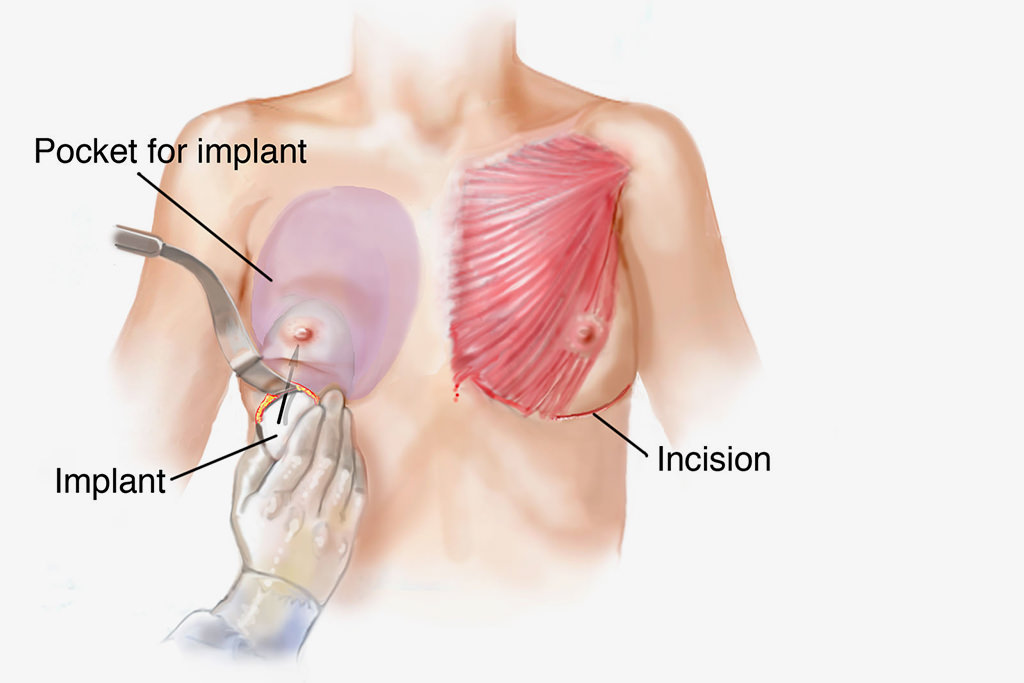
- Surgery day: simple implant exchange, without work on the capsule, can sometimes be done under local anaesthesia. If the pocket needs to be adjusted, a lift is added, or the capsule is removed, the operation is done under general anaesthesia, usually in about one to three hours, as day surgery. Whenever possible, Dr. Boudana uses the original incision, most often in the breast crease.
- Technique: the old implant is removed, with or without the capsule. The pocket is irrigated with an antibiotic or antiseptic solution, and the new implant is placed with a no-touch Keller Funnel technique, which also allows a smaller incision even for a larger implant. If breast tissue is removed, for example during a lift, it is sent to pathology.
- Follow-up: you are seen at scheduled visits, customized to your healing. Follow-up appointments are included for the first year after surgery.
If revision is combined with a drainless tummy tuck or other body procedures as part of a mommy makeover, the plan is kept within a safe operating time. If the combination would run past six hours, the procedures are staged. Surgery is performed in operating rooms accredited under the CPSO Out-of-Hospital Premises program.
What is recovery like after implant replacement?
Recovery is usually straightforward and is shorter for a simple exchange than when a lift or extensive capsule work is added. You go home the same day in a surgical bra. Most patients return to desk work within about one to two weeks, and physical activity is typically resumed at four to six weeks, once you are cleared. Our team gives you detailed written instructions, and results vary from patient to patient as swelling settles.
How much does breast implant replacement cost in Toronto?
Cost depends on whether the operation is a straightforward exchange or also includes a lift, fat transfer or capsule surgery. Starting prices are available online at drdavidboudana.com/prices, and financing options are described at drdavidboudana.com/financing. You receive a personalized quote at your consultation.
Frequently asked questions
Do I have to replace my breast implants every 10 years?
No. There is no automatic 10-year replacement rule. Many women keep the same implants much longer, and some keep them for life if they remain comfortable and the result still looks right. Surgery is recommended when there is a problem, or when you want a different size or shape.
How long do breast implants last on average?
There is no single average that applies to every patient. Modern implants can last many years, often 15 years or longer, but lifespan depends on the implant, the pocket, and how the breast changes over time. Follow-up and, for silicone implants, periodic imaging help detect issues that are not obvious from the outside.
How do I know if a silicone implant has ruptured?
Unlike a saline implant, a cohesive silicone implant may not deflate in a way you can see or feel. That is why periodic imaging, such as ultrasound or MRI, is used. If a rupture is confirmed, Dr. Boudana will discuss removal or replacement.
Can I change size when my implants are replaced?
Yes. Size change is one of the most common reasons patients choose revision. Dr. Boudana will assess your tissue and chest wall and may use 3D imaging so you can see a realistic range before you decide.
Will I need a breast lift when my implants are replaced?
Not always. If the nipple position and skin are still good, an exchange or a pocket adjustment may be enough. If the breasts have descended after pregnancy, weight change or time, a lift can be done at the same time so the new implant sits in a better position.
Can I have my implants removed without replacing them?
Yes. Implant removal can be done on its own, or combined with a breast lift or fat transfer if you want to restore shape without a new implant. Dr. Boudana will explain what your tissues are likely to do once the volume is gone.
Could implant revision affect breastfeeding?
It could affect breastfeeding, and that’s something to be discussed in consultation. If you are planning a pregnancy, tell Dr. Boudana so the timing and the surgical plan can take that into account.
What is recovery like after a simple implant exchange?
It is day surgery, so you go home the same day with a surgical bra. Most patients return to desk work within about one to two weeks. Recovery can be a little longer if a lift or capsule surgery is added, and you receive written instructions from our team.
Book a consultation with Dr. David Boudana
If you are wondering how long your breast implants will last, or whether it is time for replacement, a consultation is the best place to start. Dr. Boudana will examine you, review any imaging and recommend a plan that fits your goals. You can request a consultation online.